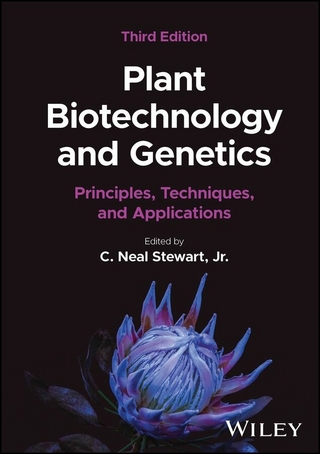
Plant Biotechnology and Genetics (eBook)
1174 Seiten
Wiley (Verlag)
978-1-394-21723-6 (ISBN)

Discover the latest edition of this authoritative textbook on plant biotechnology and genetics
Plant biotechnology is a field of research and development in which scientific techniques are brought to bear on the creation and modification of new, beneficial plants and strains. Biotechnological techniques can be used to add nutritive value, increase resistance to diseases and pests, increase yields, and more. The production of biotech crops has increased over one hundred times since their introduction into commercial agriculture in 1996, making them the most rapidly-adopted crop category in the history of modern agriculture.
Plant Biotechnology and Genetics is the essential introduction to this thriving research subject. Beginning with an overview of basic plant biology and genetics, it then moves to the fundamental elements of biotechnology. Now fully updated to reflect the latest research advances and technological breakthroughs, it continues to be a must-own for readers interested in the future of food production and more.
Readers of the third edition of Plant Biotechnology and Genetics will also find:
- New chapters covering topics like genome editing, chloroplast genome engineering, and synthetic biology
- Updates throughout to incorporate increased coverage of haploid production, genomic selection, and more
- Summary and discussion questions in each chapter, along with a companion website incorporating images and lecture materials
Plant Biotechnology and Genetics is ideal for advanced undergraduate and masters students in plant biotechnology courses, as well as professionals seeking a helpful reference guide.
C. Neal Stewart Jr., PhD, holds the Racheff Chair of Excellence in Plant Molecular Genetics and is a Professor in the Department of Plant Sciences at the University of Tennessee, Knoxville. He also serves as co-director of the Center for Agricultural Synthetic Biology, which Stewart co-founded in 2018. In addition to the prior editions of Plant Biotechnology, he has written Weedy and Invasive Plant Genomics, Plant Transformation Technologies, and Research Ethics for Scientists: A Companion for Students, all published by Wiley.
Discover the latest edition of this authoritative textbook on plant biotechnology and genetics Plant biotechnology is a field of research and development in which scientific techniques are brought to bear on the creation and modification of new, beneficial plants and strains. Biotechnological techniques can be used to add nutritive value, increase resistance to diseases and pests, increase yields, and more. The production of biotech crops has increased over one hundred times since their introduction into commercial agriculture in 1996, making them the most rapidly-adopted crop category in the history of modern agriculture. Plant Biotechnology and Genetics is the essential introduction to this thriving research subject. Beginning with an overview of basic plant biology and genetics, it then moves to the fundamental elements of biotechnology. Now fully updated to reflect the latest research advances and technological breakthroughs, it continues to be a must-own for readers interested in the future of food production and more. Readers of the third edition of Plant Biotechnology and Genetics will also find: New chapters covering topics like genome editing, chloroplast genome engineering, and synthetic biologyUpdates throughout to incorporate increased coverage of haploid production, genomic selection, and moreSummary and discussion questions in each chapter, along with a companion website incorporating images and lecture materials Plant Biotechnology and Genetics is ideal for advanced undergraduate and masters students in plant biotechnology courses, as well as professionals seeking a helpful reference guide.
CHAPTER 1
The Impact of Biotechnology on Plant Agriculture
GRAHAM BROOKES
PG Economics Ltd, Dorchester, UK
1.0. CHAPTER SUMMARY AND OBJECTIVES
1.0.1. Summary
Since the first stably transgenic plant produced in the early 1980s and the first commercialized transgenic plant in 1994, biotechnology has revolutionized plant agriculture. In the United States, more than 90% of the maize (corn), soybean, cotton, and canola crops are transgenic for insect resistance, herbicide resistance, or both. Plant biotechnology has been one of the most rapidly adopted technologies in the history of agriculture and continues to expand in much of the developed and developing world.
1.0.2. Discussion Questions
- What biotechnology crops are grown and where?
- Why do farmers use biotech crops?
- How has the adoption of plant biotechnology impacted the environment?
1.1. INTRODUCTION
The technology of genetic modification (GM, also stands for “genetically modified”), which consists of genetic engineering and also known as genetic transformation, has now been utilized globally on a widespread commercial basis for more than a quarter of century; and in 2020, over 18 million farmers in 26 countries had planted 185.6 million hectares of crops using this technology. These milestones provide an opportunity to critically assess the impact of this technology on global agriculture. This chapter therefore examines specific global socioeconomic impacts on farm income and environmental impacts with respect to pesticide usage and greenhouse gas (GHG) emissions of the technology. Further details can be found in Brookes (2022a, b and c).
1.2. CULTIVATION OF BIOTECHNOLOGY (GM) CROPS
Although the first commercial GM crops were planted in 1994 (tomatoes), 1996 was the first year in which a significant area of crops containing GM traits were planted (1.66 million hectares). Since then, there has been a dramatic increase in plantings, and in 2020, the area planted to crops utilizing GM seed technology was 185.6 million hectares.
Almost all of the global GM crop area derives from soybean, maize (corn), cotton, and canola (Fig. 1.1). In 2020, GM soybean accounted for the largest share (50%) of total GM crop cultivation, followed by maize (33%), cotton (12%), and canola (5%). In terms of the share of total global plantings to these four crops accounted for by GM crops, GM traits accounted for a majority of soybean grown (72%) in 2020 (i.e., non‐GM soybean accounted for 28% of global soybean acreage in 2020). For the other three main crops, the GM shares in 2020 of total crop production were 31% for maize, 76% for cotton, and 27% for canola (i.e., the majority of global plantings of maize and canola continued to be non‐GM in 2020). The trend in plantings of GM crops (by crop) from 1996 to 2020 is shown in Figure 1.2. In terms of the type of biotechnology trait planted, Figure 1.3 shows that GM herbicide‐tolerant soybeans dominate, accounting for 33.6% of the total, followed by herbicide‐tolerant and insect‐resistant (largely Bt) maize, herbicide‐tolerant maize, insect‐resistant soybeans (also containing herbicide‐tolerant technology), and insect‐resistant cotton with respective shares of 21, 20.9, 10.8, and 8.3%. It is worth noting that the total number of plantings by trait produces a higher global planted area (274.3 million hectares) than the global area by crop (185.6 million hectares) because of the planting of crops containing the stacked traits of herbicide tolerance and insect resistance (e.g., a single plant with two biotech traits). In total, 46% of global GM crop plantings in 2020 contained stacked traits, 44% contained only herbicide‐tolerant (GM HT) traits, and 10% only insect‐resistant (GM IR) traits. Finally, looking at where biotech crops have been grown, the United States had the largest share of global GM crop plantings in 2020 (36%: 66.8 million hectares), followed by Brazil (55.7 million hectares: 30% of the global total) and Argentina (12%: 22.3 million hectares). The other main countries planting GM crops in 2020 were India, Canada, and China (Fig. 1.4). In 2020, there were also additional GM crop plantings of papaya (187 hectares), squash (1000 hectares), alfalfa (1.26 million hectares), sugar beet (462,300 hectares), and potatoes (1780 hectares) in the United States, of papaya (9000 hectares) in China, of sugar beet (17,000 hectares) in Canada and 6309 hectares of insect resistant brinjal in Bangladesh.
Figure 1.1. Global GM crop plantings in 2020 by crop (base area: 185.6 million hectare).
(Source: ISAAA, Canola Council of Canada, CropLife Canada, USDA, CSIRO, ArgenBio.)
Figure 1.2. Global GM crop plantings by crop 1996–2020.
(Source: ISAAA, Canola Council of Canada, CropLife Canada, USDA, CSIRO, ArgenBio.)
Figure 1.3. Global GM crop plantings by main trait and crop: 2020.
(Source: Various, including ISAAA, Canola Council of Canada, CropLife Canada, USDA, CSIRO, ArgenBio.)
Figure 1.4. Global GM crop plantings 2020 by country.
(Sources: ISAAA, Canola Council of Canada, CropLife Canada, USDA, CSIRO, ArgenBio, Various including ISAAA, Canola Council of Canada, CropLife Canada, USDA, CSIRO, ArgenBio, National Ministries of Agriculture (Mexico, Philippines, Spain, Vietnam), Grains South Africa.)
1.3. WHY FARMERS USE BIOTECH CROPS
The primary driver of adoption among farmers (both large commercial and small‐scale subsistence) has been the positive impact on farm income. GM technology has had a significant positive impact on farm income derived from a combination of enhanced productivity and efficiency gains (Figs. 1.5 and 1.6). In 2020, the direct global farm income benefit from GM crops was $18.8 billion. This is equivalent to having added 5.9% to the value of global production of the four main crops of soybeans, maize, canola, and cotton. Since 1996, farm incomes have increased by $261.3 billion.
Figure 1.5. Global GM crop farm income benefits 2020: baseline total $18.8 billion. Notes: Others = HT sugar beet, Virus resistant papaya and squash, drought tolerant maize and IR brinjal.
Figure 1.6. Cumulative global GM crop farm income benefits 1996–2020: baseline total $261.3 billion. Notes: Others = HT sugar beet, Virus resistant papaya and squash, drought tolerant maize and IR brinjal.
The largest gains in farm income in 2020 have arisen in the maize sector, largely from yield gains. The $3.7 billion additional income generated by GM insect resistant (GM IR) maize in 2020 has been equivalent to adding 6.3% to the value of the crop in the GM crop‐growing countries, or adding, the equivalent of 2.8% to the $133 billion value of the global maize crop in 2020. Cumulatively since 1996, GM IR technology has added $67.8 billion to the income of global maize farmers.
Substantial gains have also arisen in the cotton sector through a combination of higher yields and lower costs. In 2020, cotton farm income levels in the GM adopting countries increased by $3.94 billion, and since 1996, the sector has benefited from an additional $73.11 billion. The 2020 income gains are equivalent to adding 12.1% to the value of the cotton crop in these countries or 12% to the $32.7 billion value of total global cotton production. This is a substantial increase in value added terms for two categories of cotton seed technology.
Significant increases to farm incomes have also resulted in the soybean and canola sectors. The GM herbicide tolerant (HT) technology in soybeans has boosted farm incomes by $5.64 billion in 2020, and since 1996 has delivered $74.65 billion of extra farm income. The adoption of “Intacta” soybeans (combining HT and IR traits) in South America since 2013 also provided $16 billion of additional farm income. In the canola sector (largely North American) an additional $8.2 billion has been generated (1996–2020).
Figures 1.7 and 1.8 summarize farm income impacts in key GM crop adopting countries. These highlight the important farm income benefit arising from GM HT soybeans in South America (Argentina, Bolivia, Brazil, Paraguay, and Uruguay), GM IR cotton in China and India, and the range GM crop adoption in the US. Figure 1.8 in particular (the increasing share of “other countries”) also illustrates the growing level of farm income benefits being obtained in countries that were later adopters of GM crop technology such as Pakistan, the Philippines, and Colombia.
In terms of the division of the economic benefits obtained by farmers in developing countries relative to farmers in developed countries, in 2020, 55% of the farm income benefits have been earned by developing country farmers. The vast majority of these income gains for developing country farmers have been from GM IR cotton and GM HT soybeans. Over the 25 years, 1996–2020, the cumulative farm income gain derived by developing country farmers was 52% ($136.6 billion).
Figure 1.7. Cumulative global GM crop farm income benefits 1996–2020 by country: baseline total $261.3 billion
...| Erscheint lt. Verlag | 27.3.2025 |
|---|---|
| Sprache | englisch |
| Themenwelt | Naturwissenschaften ► Biologie ► Botanik |
| Schlagworte | Agri-biotech applications • biotech crop • chloroplast genome engineering • Disease resistance • gene expression, synthetic promoters • Genome editing • genomic selection • Pest resistance • Plant Biotechnology • Plant signaling • Synthetic biology • vector construction |
| ISBN-10 | 1-394-21723-4 / 1394217234 |
| ISBN-13 | 978-1-394-21723-6 / 9781394217236 |
| Informationen gemäß Produktsicherheitsverordnung (GPSR) | |
| Haben Sie eine Frage zum Produkt? |
 EPUB (Adobe DRM)
Kopierschutz: Adobe-DRM
Adobe-DRM ist ein Kopierschutz, der das eBook vor Mißbrauch schützen soll. Dabei wird das eBook bereits beim Download auf Ihre persönliche Adobe-ID autorisiert. Lesen können Sie das eBook dann nur auf den Geräten, welche ebenfalls auf Ihre Adobe-ID registriert sind.
Details zum Adobe-DRM
Dateiformat: EPUB (Electronic Publication)
EPUB ist ein offener Standard für eBooks und eignet sich besonders zur Darstellung von Belletristik und Sachbüchern. Der Fließtext wird dynamisch an die Display- und Schriftgröße angepasst. Auch für mobile Lesegeräte ist EPUB daher gut geeignet.
Systemvoraussetzungen:
PC/Mac: Mit einem PC oder Mac können Sie dieses eBook lesen. Sie benötigen eine
eReader: Dieses eBook kann mit (fast) allen eBook-Readern gelesen werden. Mit dem amazon-Kindle ist es aber nicht kompatibel.
Smartphone/Tablet: Egal ob Apple oder Android, dieses eBook können Sie lesen. Sie benötigen eine
Geräteliste und zusätzliche Hinweise
Buying eBooks from abroad
For tax law reasons we can sell eBooks just within Germany and Switzerland. Regrettably we cannot fulfill eBook-orders from other countries.
aus dem Bereich