


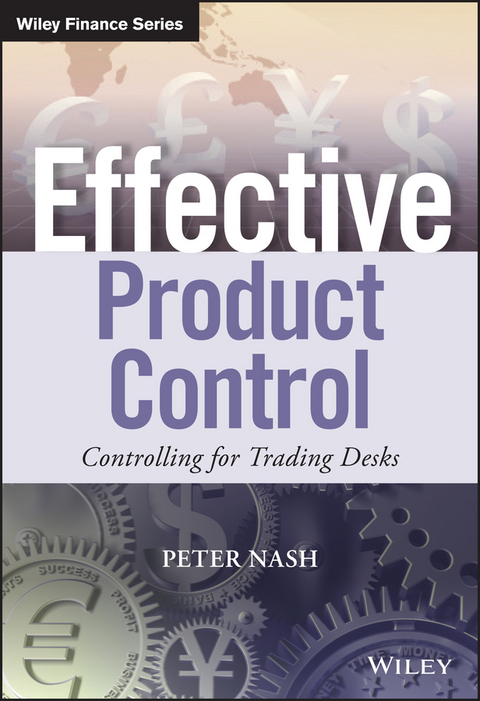
Effective Product Control (eBook)
John Wiley & Sons (Verlag)
978-1-118-93980-2 (ISBN)

PETER NASH is a qualified accountant who has spent almost two decades controlling a wide range of sales and trading desks in Investment and Commercial banks. He is currently a Director of FINSED (www.finsed.com), a financial services training and consulting firm specialising in product control.
Improve the Effectiveness of your Product Control Function Effective Product Control is a detailed how-to guide covering everything you need to know about the function. Considered essential reading for: New controllers entering the profession Auditors and regulators reviewing product control Established controllers wanting a refresher on the latest skills and core controls within the industry. Encompassing both a technical skills primer and key insights into core controls used to mit igate major risks emanating from trading desks, you will get expert advice on practical topics such as: The key IFRS and U.S. GAAP accounting standards for a trading desk How to approach the pricing of a financial instrument Market risk and how is it quantified The controls necessary for a trading desk Rogue trading and how it can be detected Valuation adjustments and why they are necessary How the prices used to value a trading portfolio are independently verified The financial accounting entries used to record financial instruments in the balance sheet and profit & loss statement Financial reporting and how the results of a trading desk are presented How a new financial product can be introduced in a controlled manner Complete with a wealth of insightful graphs, illustrations and real-world examples to enliven the covered material, the dependable answers you need are in Effective Product Control.
PETER NASH is a qualified accountant who has spent almost two decades controlling a wide range of sales and trading desks in Investment and Commercial banks. He is currently a Director of FINSED (www.finsed.com), a financial services training and consulting firm specialising in product control.
CHAPTER 1
An Introduction to Product Control
The Emergence of Product Control
Finance within banking is unlike finance in most other types of industries. In most non-banking companies, the finance team is separate from the producer. For example, in a manufacturing company the finance department is not on the shop floor, and in a retail company it is not in the stores. Most likely, finance is housed in the head office.
In these industries, the value of the product is not often in dispute. Usually the cost of sales and production, or margin per unit, is known and the revenues are the function of a simple calculation. There is also often a team of management accountants providing information to the product line managers on the results of their business and assisting in analytics on those results.
In banking, it is not that simple. Finance is more integral to the production because the products banks deliver are financial. In the 1990s, with increasing volumes of trading, a greater pool of financial instruments and higher levels of complexity, it was necessary for banks to establish a dedicated function within finance to control evolving sales and trading desks. With that, management accountants within finance morphed and grew into a function called product control, which came to dominate large swathes of finance, establishing footprints all over the developed world and later on, the developing world.
Over the past decade, these large swathes have been migrating from the more expensive financial centres such as London, New York, Tokyo, Hong Kong and Singapore, to cheaper locations such as India, Poland and the Philippines. This change has presented opportunities for aspiring workers in the developing nations and presented uncertain career paths for those remaining in the shrinking financial centres.
We will look at this trend in more detail in Chapter 2.
The Purpose of Product Control
Product control is the face of finance to the sales and trading desks in a bank. They provide financial control and transparency through (Figure Figure 1.1):
- Providing a profit and loss statement and balance sheet which is accurate and timely;
- Providing meaningful insight into the desk's financial results;
- Supporting the desk in the execution of their business strategy; and
- Evaluating and integrating new products into the financial environment.
Product control's purpose is executed through a series of controls across the P&L and balance sheet, many of which are performed daily. On top of these controls, product control's financial acumen and understanding of the bank's systems can be used to support the execution of the desk's business strategy. This includes providing insight into drivers of financial performance, reviewing the desk's use of legal entities within the banking group and assessing the efficiency of process workflows.
Figure 1.1 The purpose of product control
The centrepiece of the product control role is the daily P&L (Figure 1.2). If you aren't familiar with this term, it measures the income and expenses for the sales and trading desks. If the sum of the income from trading activities, client sales and trading expenses is greater than zero, a profit is reported, otherwise a loss is reported.
Figure 1.2 The P&L
We will explore the controls that product control normally execute in greater detail throughout Parts III through VII of the book.
Different Types of Product Control
Before we can explore the role of product control further we need to be aware that not every organization will share the same mandate for their product control function. Although there will be exceptions to this, we can broadly categorize the function into one of two types:
- P&L only
- P&L, balance sheet and financial reporting.
P&L Only
The P&L-focused role is, as its name suggests, focused purely on the P&L. In firms across the industry this function may also be labelled as middle office. The review and substantiation of the balance sheet and financial reports are performed by a separate team(s) within finance.
There are benefits and drawbacks for any organizational structure. There are two main benefits to this model. First, it relies on a team with a narrower skill set, which can improve the control framework as the product controller does not have to be an expert in an excessive number of disciplines (accounting, risk management, financial reporting, etc.). Second, as the skill set is narrower it should be easier for the firm to hire and develop their talent.
The primary but manageable drawback to this structure is that a single team is not controlling all the financial aspects of the desk and weakness in the control framework arises when the roles and responsibilities of the different finance teams are not clearly defined and understood by all staff.
For example, the product controllers for the credit trading desk are aware of a late trade booking for 31 December (financial year end) that has missed the end of day report batches that are used to populate the P&L reporting system and general ledger (GL) for financial reporting. The product controller determines the trade has an immaterial impact on the P&L so decides not to adjust the P&L.
Although the trade had an immaterial impact on the P&L, it had a material impact on balance sheet usage, which the financial controllers will not be aware of. Consequently, the firm's year-end reporting misstates not only the balance sheet size and shape, but also the capital ratios, as the risk-weighted assets (RWAs) did not take this late trade into consideration.
This drawback can be compensated for by having clear roles and responsibilities and up-to-date standard operating procedures (SOPs) for each function. These documents make clear the control framework which the firm has in place for each desk.
Each task and responsibility should be documented extensively and refer to what is a control exception and when that exception should be escalated. In this example, the SOPs could require product control to adjust the month-end financials (both P&L and balance sheet) for every late trade.
P&L: Balance Sheet and Financial Reporting Focus
A broader version of product control includes responsibilities which cover the P&L, balance sheet and some financial reporting for the bank.
This product controller is aware that changes in the balance sheet are the driver of P&L performance and as such it is critical that the balance sheet is reviewed, substantiated and understood.
This product controller will perform the same functions as the P&L-only controller in addition to the following tasks:
- Review and substantiation of the balance sheet
- Advising the desk on the accounting treatment for their transactions (if further expertise is not required from accounting policy)
- Assisting financial reporting in their review of the financial reports, including note disclosures
- Populating the GL with any necessary financial accounting entries.
As product control cover a substantial portion of the control framework assigned to finance, the bank benefits from a single team monitoring all aspects of the desk's financial performance (i.e., the P&L, balance sheet and financial reporting). This set-up should ensure both the P&L and balance sheet are aligned and that by seeing the full financial picture, issues are more readily identifiable.
The main drawbacks of this structure relate to the breadth of responsibilities being undertaken. As the product controller needs to be skilled in many more disciplines than the P&L-only function, it can be more difficult to recruit and develop talent. Additionally, so many responsibilities may cause some to be neglected.
As before, these drawbacks can also be compensated for by having clear roles and responsibilities and complete standard operating procedures.
For the purposes of this book we will focus on this type of product control function.
Skills, Qualifications and Experience
Product control has historically employed candidates with varying levels of experience but one of the most common recruitment styles of banks has been to employ candidates who, after completing three years of work experience in an accounting firm and passing their accounting exams, have qualified as chartered accountants. These chartered accountants would then be brought into the product control function and be trained up to control the sales and trading desks.
Over time, these candidates would gain the necessary experience to move through the product control ranks by becoming senior product controllers and then product control managers.
Accountants who, for various reasons, have decided not to train in accounting firms are also very prevalent in the product control ranks. These candidates commonly spend their qualifying period working within the financial services sector at banks, fund managers, credit rating agencies and so on. This means they have different, but equally valuable, experiences to bring to product control.
Once in product control both sets of candidates can further their qualifications and skills by taking postgraduate courses.
Table 1.1 lists the product control hierarchy and the typical experience, qualifications and skill sets that you could expect to...
| Erscheint lt. Verlag | 28.9.2017 |
|---|---|
| Reihe/Serie | The Wiley Finance Series |
| Wiley Finance Series | Wiley Finance Series |
| Sprache | englisch |
| Themenwelt | Recht / Steuern ► Wirtschaftsrecht |
| Wirtschaft ► Betriebswirtschaft / Management ► Finanzierung | |
| Schlagworte | Effective Financial Product Control: Managing Risk by Guarding Sales and Trading Activities • efficient product control • Finance & Investments • financial product control handbook • financial product control reference • financial product control tasks • Finanz- u. Anlagewesen • FXMM Product Control • Institutional & Corporate Finance • Institutionelle Finanzplanung • Peter Nash • practical financial product control • product control function • product control guide • product control manual • product control personnel • product control processes • product control workflows • Risk Management • ubs london |
| ISBN-10 | 1-118-93980-8 / 1118939808 |
| ISBN-13 | 978-1-118-93980-2 / 9781118939802 |
| Informationen gemäß Produktsicherheitsverordnung (GPSR) | |
| Haben Sie eine Frage zum Produkt? |
 EPUB (Adobe DRM)
Kopierschutz: Adobe-DRM
Adobe-DRM ist ein Kopierschutz, der das eBook vor Mißbrauch schützen soll. Dabei wird das eBook bereits beim Download auf Ihre persönliche Adobe-ID autorisiert. Lesen können Sie das eBook dann nur auf den Geräten, welche ebenfalls auf Ihre Adobe-ID registriert sind.
Details zum Adobe-DRM
Dateiformat: EPUB (Electronic Publication)
EPUB ist ein offener Standard für eBooks und eignet sich besonders zur Darstellung von Belletristik und Sachbüchern. Der Fließtext wird dynamisch an die Display- und Schriftgröße angepasst. Auch für mobile Lesegeräte ist EPUB daher gut geeignet.
Systemvoraussetzungen:
PC/Mac: Mit einem PC oder Mac können Sie dieses eBook lesen. Sie benötigen eine
eReader: Dieses eBook kann mit (fast) allen eBook-Readern gelesen werden. Mit dem amazon-Kindle ist es aber nicht kompatibel.
Smartphone/Tablet: Egal ob Apple oder Android, dieses eBook können Sie lesen. Sie benötigen eine
Geräteliste und zusätzliche Hinweise
Buying eBooks from abroad
For tax law reasons we can sell eBooks just within Germany and Switzerland. Regrettably we cannot fulfill eBook-orders from other countries.
aus dem Bereich


