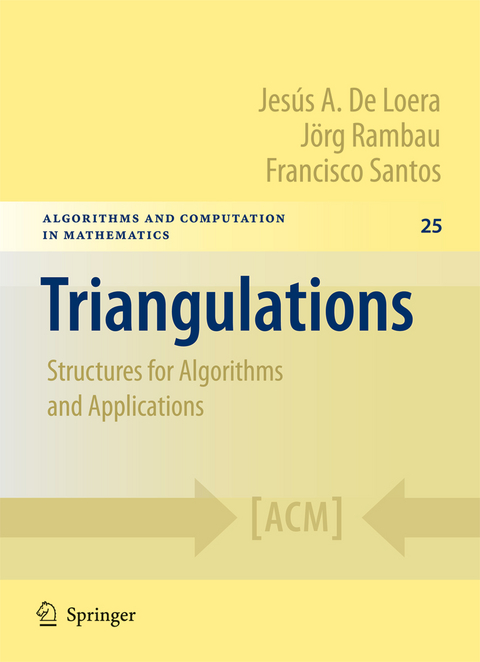
Triangulations
Springer Berlin (Verlag)
978-3-642-12970-4 (ISBN)
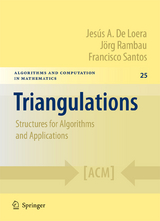
J.A. De Loera is a professor of mathematics at the University of California, Davis. His work approaches difficult computational problems in discrete mathematics and optimization using tools from algebra and convex geometry. His research has been recognized by an Alexander von Humboldt Fellowship and several national and international grants. He is an associate editor of the journal "Discrete Optimization". Jörg Rambau is the chair professor of Wirtschaftsmathematik (Business Mathematics) at the Universität of Bayreuth since 2004. Before that he was associate head of the optimization department at the Zuse Institute Berlin (ZIB). His research encompasses problems in applied optimization, algorithmic discrete mathematics and combinatorial geometry. He is the creator of the state of the art program for triangulation computations TOPCOM. He is associate editor of the "Jahresberichte der Deutschen Mathematiker-Vereinigung". Francisco Santos, a professor at the Universidad de Cantabria Spain, received the Young Researcher award from the Universidad Complutense de Madrid in 2003 and was an invited speaker in the Combinatorics Section of the International Congress of Mathematicians in 2006. He is well-known for his explicit constructions of polytopes with disconnected spaces of triangulations, some of which are featured in this book. He is an editor of Springer Verlag's journal "Discrete and Computational Geometry".
Triangulations in Mathematics.- Configurations, Triangulations, Subdivisions, and Flips.- Life in Two Dimensions.- A Tool Box.- Regular Triangulations and Secondary Polytopes.- Some Interesting Configurations.- Some Interesting Triangulations.- Algorithmic Issues.- Further Topics.
From the reviews:
"Focusing on the structure of the set of all possible triangulations ... the current study sits at the threshold of geometry and combinatorics ... . offering terra firma to students still struggling with abstraction, the central theorem ... only dates to 1989, so the present elaboration carries readers to the frontiers of research. ... It is unusual to find such a leisurely, generous exposition of a new subject, as replete with illustrations as contemporary calculus textbooks. ... Summing Up: Recommended. Upper-division undergraduates through professionals." (D. V. Feldman, Choice, Vol. 49 (1), September, 2011)
"This book masterfully presents the theory of triangulations of (the convex hull of) a point set alongside many appealing applications in algebra, computer science, combinatorics, and optimization. ... The writing is thorough and engaging, assisted by clear (and numerous) illustrations, and many exercises for the reader. Graduate students and researchers in any area in which triangulations of points set configurations play a role will find this book a comprehensive and most useful reference." (Matthias Beck, Zentralblatt MATH, Vol. 1207, 2011)
| Erscheint lt. Verlag | 6.9.2010 |
|---|---|
| Reihe/Serie | Algorithms and Computation in Mathematics |
| Zusatzinfo | XIII, 535 p. |
| Verlagsort | Berlin |
| Sprache | englisch |
| Maße | 193 x 260 mm |
| Gewicht | 1468 g |
| Themenwelt | Mathematik / Informatik ► Mathematik ► Geometrie / Topologie |
| Schlagworte | algorithms • Computational Geometry • convex geometry • Graph • polyhedral subdivisions • polytopes • Triangulation (geo.) • triangulations |
| ISBN-10 | 3-642-12970-6 / 3642129706 |
| ISBN-13 | 978-3-642-12970-4 / 9783642129704 |
| Zustand | Neuware |
| Haben Sie eine Frage zum Produkt? |
aus dem Bereich